
Joy Born from Despair: Beethoven’s Symphony No. 9

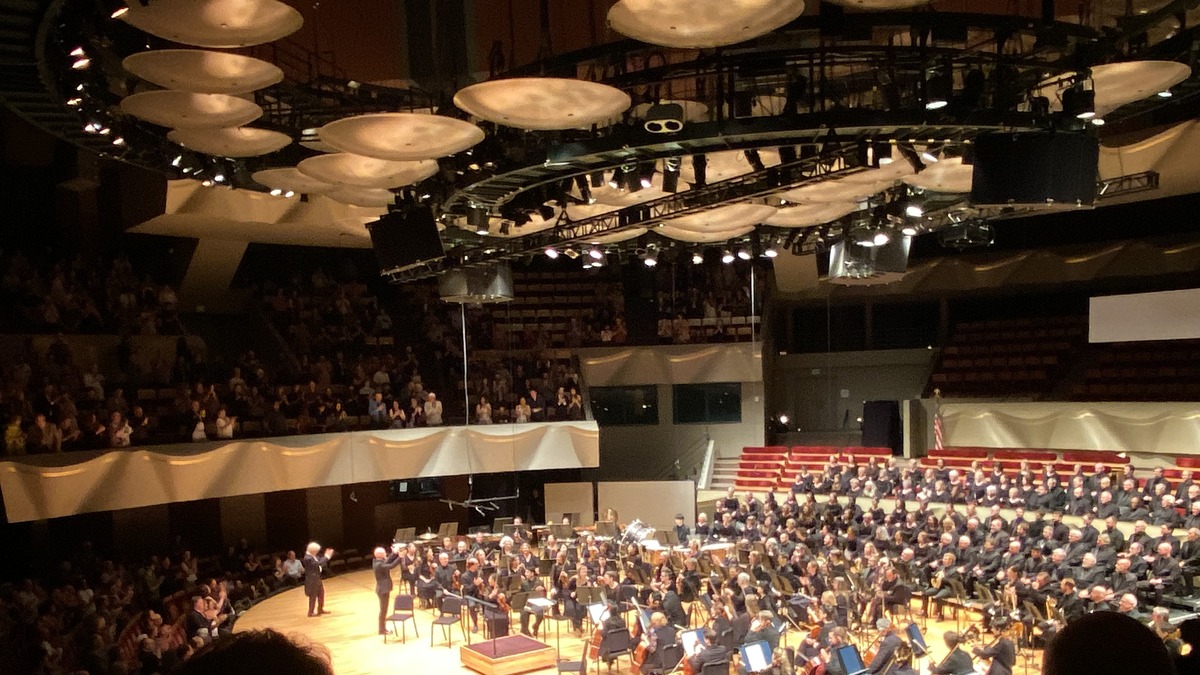
(Denver, CO = Won Jeong) From Sept. 11 through 13, the Colorado Symphony presented Beethoven’s Symphony No. 9 at Boettcher Concert Hall in the Denver Performing Arts Complex.
Led by Music Director Peter Oundjian, the performances featured the Colorado Symphony Chorus along with soprano, mezzo-soprano, tenor and bass-baritone soloists. The vast sound of the orchestra, joined by the human voice, filled the concert hall with the grandeur that has made Beethoven’s Ninth one of the most celebrated works in classical music.
Listening to Beethoven’s Symphony No. 9 brings the audience face to face with a remarkable paradox.
By the time Beethoven completed a work filled with such an extraordinary richness of sound and human voices, he himself could hear almost none of it.
Born in 1770, Beethoven was 53 when the Ninth Symphony premiered in 1824. His hearing loss, which had troubled him for years, had become so severe that he often relied on conversation books to communicate with others.
Yet the music he created within that nearly silent world can sound surprisingly warm and peaceful. At times, it even carries an almost spiritual sense of grace.
A composer who was losing the sounds of the outside world did not choose despair for his final completed symphony.
He chose joy.
That fact suggests that a desperate situation does not necessarily have to end in despair. Art — and perhaps human life itself — can sometimes shine more brightly and bloom even in the midst of suffering.
That message becomes especially powerful in the fourth and final movement.
Beethoven turned to German poet Friedrich Schiller’s Ode to Joy (An die Freude), bringing Schiller’s words into the symphony. At the time, incorporating solo voices and a full chorus on such a scale into a symphony was a groundbreaking idea.
Schiller repeatedly explored ideals such as freedom, human dignity, humanity and brotherhood in his work. Ode to Joy is therefore more than a poem simply celebrating happiness. At its heart is a vision of a world in which people recognize one another as brothers and become united beyond their divisions.
Beethoven had reportedly considered setting Schiller’s Ode to Joy to music since his younger years. Words that had remained in his mind for decades ultimately became the human voice at the conclusion of one of the most monumental works of his life.
For Beethoven, who was facing profound physical and emotional hardship as his hearing disappeared, Schiller’s vision of joy and human fellowship may have appeared like a beam of light in the darkness.
Nearly 200 years later, that light continues to reach those who hear Beethoven’s Ninth Symphony.
The historical circumstances surrounding the work were hardly peaceful either.
The unified Germany we know today did not yet exist. Prussia and other German states, as well as Austria, had only recently emerged from the long era of the Napoleonic Wars. After Napoleon’s defeat in 1815, European powers attempted to restore the old political order through the Congress of Vienna. In Austria, where Beethoven lived, the Metternich system brought tighter censorship and increasing restrictions on liberal and nationalist movements.
The wars had ended, but peace on the battlefield did not mean that the lives of ordinary people suddenly became peaceful.
And yet art continued to bloom.
Beethoven created his Ninth Symphony.
The Colorado Symphony performances from Sept. 11 through 13 also coincided with a time when Americans were remembering the tragedy of the Sept. 11 attacks. Twenty-five years after that tragedy, Beethoven’s music — with its message of human fellowship and unity — carried another layer of meaning.
In individual lives, as in the larger course of history, suffering and despair inevitably appear.
Yet Beethoven’s Ninth seems to suggest that despair does not have to be the only response.
A composer who was losing his hearing wrote music about joy.
A man who had lived through an era of war and division gave voice to the idea of human brotherhood.
If great art could be born in such a time, perhaps somewhere in our own troubled era, beautiful writing and beautiful music are also being conceived at this very moment.
No — they almost certainly are.
Because art is not limited by time or place.
It is born from the endurance of an individual, and from something that takes shape deep within the human heart.


